
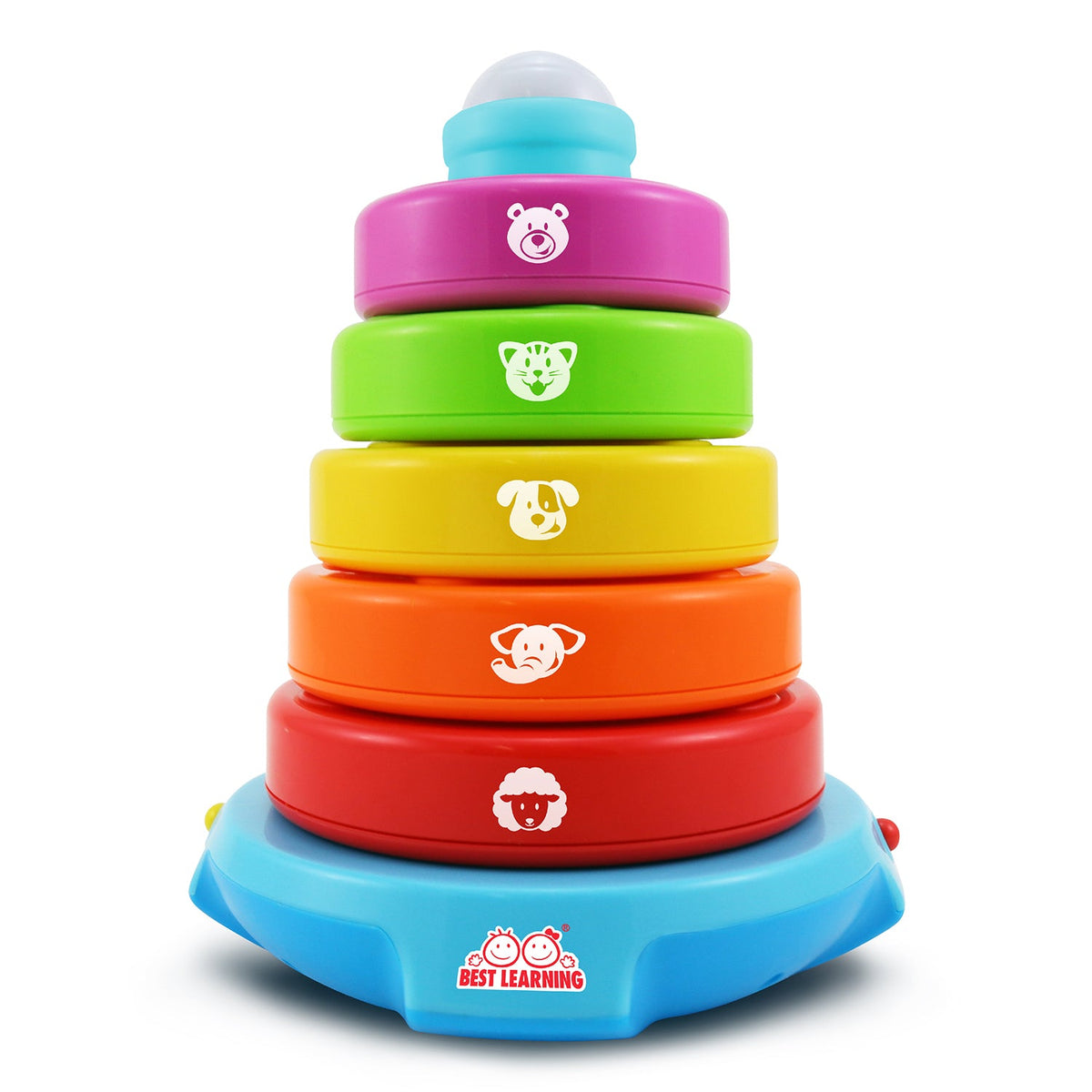
Stacking toys look simple – and that is the point. Putting one piece on top of another is one of the first "problems" a baby solves on purpose. This guide explains why stacking matters, what makes a good stacking toy at each age, and how to pick one.
Why stacking is such good learning
Each time a child stacks a ring or a block, several things happen at once:
- Hand-eye coordination – aiming the piece and placing it where the eyes say it should go.
- Fine motor control – gripping, lifting, letting go at the right moment.
- Size and order – big ring first, small ring last. This is early math.
- Cause and effect – stack it wrong and it falls. Stack it right and it stays.
- Patience and focus – trying again after the tower falls is a skill in itself.
Because the task is so clear, children repeat it on their own, with no adult instruction. That self-driven repetition is the best kind of practice.
Types of stacking toys
| Type | Typical age | What it teaches |
|---|---|---|
| Stacking rings on a post | 6 months+ | Grip, aim, size order, colors |
| Stacking cups | 6 months+ | Nesting, size order, pouring in the bath |
| Soft or wooden blocks | 12 months+ | Balance, free building, knocking down |
| Shape and magnetic blocks | 2 years+ | Shapes, angles, 2D vs 3D, planning a build |
| Interactive stacking toys with sounds | 6 months+ | All of the above, plus colors, animals, numbers or music as feedback |
What to look for
- A stable base. Rings should slide on easily; blocks should stand without tipping. Frustration kills interest fast.
- Pieces sized for small hands. Too small is a choking risk; too big is hard to grip. Check the recommended age.
- Clear size steps. Each piece should be visibly bigger or smaller than the next, so the child can learn the order.
- Something extra as the child grows. Colors to name, animals to hear, numbers to count. A stacking toy that only stacks is outgrown in months; one with a second layer of learning lasts longer.
- Easy to clean. Rings and blocks go in mouths. Smooth plastic wipes clean.
Our picks
Stack & Learn – interactive stacking rings (6 months+)
Stack & Learn is our take on the classic stacking rings. Five colorful rings go on a musical base, and each ring stands for a color, an animal or an instrument depending on the mode. Three play modes:
- Color mode – five colors with related objects and color songs.
- Animal mode – five animal friends with their sounds and animal songs.
- Orchestra mode – three well-known orchestral pieces featuring five instruments.
Adjustable volume, auto power-off after one minute, and 3 AAA batteries included. Recommended age 6 months and up. It won Creative Child's Toy of the Year and Creative Play of the Year, and a Mom's Choice Gold Medal, in 2019.
My Geo-Blox – shape and building blocks (24 months+)
Once a child has mastered rings, My Geo-Blox is the next step. Five color-coded geometric blocks with built-in small magnets (made to safety regulations) are easy for young children to put together. A cardboard picture book introduces colors, 2D and 3D shapes. Children can touch the block corners to count angles – early geometry without a worksheet. No batteries. Recommended age 24 months and up.
Simple stacking games to try at home
- Big to small. Hand the rings in the wrong order and let the child discover why the tower looks odd.
- Color call-out. "Can you find the red ring?" Then stack it.
- Knock it down. Build it, count the pieces, let the child topple it. Repeat. Counting sneaks in every time.
- Copy my tower. With blocks, build a 3-piece shape and ask the child to make the same one.
Frequently asked questions
At what age can a baby start stacking toys?
Most stacking rings are rated from 6 months. At that age a baby mostly grabs, mouths and knocks the rings off; placing them on the post usually comes closer to the first birthday. Both stages are useful play.
Are stacking toys good for 2 and 3 year olds?
Yes, if the toy has something more to offer. At 2 and 3, children enjoy the color, animal and music modes of an interactive stacker, and are ready for shape and magnetic blocks that let them build their own designs.
Wooden or plastic stacking rings?
Both work for the basic skill. Plastic allows lights, sounds and extra learning modes, and is easier to wipe clean. Wooden sets are quieter and simpler. Many families end up with one of each.
Where can I find more toys for this age?
See the 6–36 months collection.