Searching for the best educational toys for toddlers brings up thousands of options, and most of them promise the same thing: fun and learning. This guide keeps it simple. First, what a toddler is actually ready to learn between about 1 and 3 years old. Then, what to look for in a toy. Finally, our own picks, with the real age rating for each.
What toddlers learn through play
Between the first and third birthday, children work on a few big skills at once:
- Fine motor skills – grabbing, stacking, pressing, turning. Small hands need practice.
- Hand-eye coordination – putting a ring on a post or a card into a slot.
- First words and sounds – naming colors, animals, letters and numbers.
- Cause and effect – "when I press this, something happens."
- Attention and memory – following a simple game or pattern.
A good educational toy for this age touches two or three of these at the same time, and lets the child repeat the action as often as they like. Repetition is how toddlers learn.
What to look for in a toddler learning toy
- The right age rating. Check the recommended age on the box or product page. A toy made for a 6-month-old baby is often still right for an 18-month-old, but a toy for 3-year-olds may be frustrating for a 2-year-old.
- Hands-on, not screen-based. Buttons, rings, cards and blocks give toddlers something physical to do. Lights and sounds are fine as feedback; a screen is not needed at this age.
- More than one way to play. Toys with several modes (colors, numbers, music, quiz) stay interesting longer as the child grows.
- Volume control. You will hear this toy many, many times. Two volume levels is a real feature.
- Sturdy parts. Toddlers drop, throw and chew. Look for thick plastic pieces rather than thin cardboard or small parts.
- Batteries included. A small thing, but it means the toy works on day one.
Our picks by age
All of the toys below are made by BEST LEARNING. The ages are the recommended ages from each product's specifications, not marketing claims.
From 6 months: first learning toys
Stack & Learn – A new take on the classic stacking rings. Five rings in five colors, with three play modes: colors, animal sounds, and an orchestra mode with three classical pieces. Stacking builds hand-eye coordination; the modes add colors, animals and music on top. Recommended age 6 months and up.
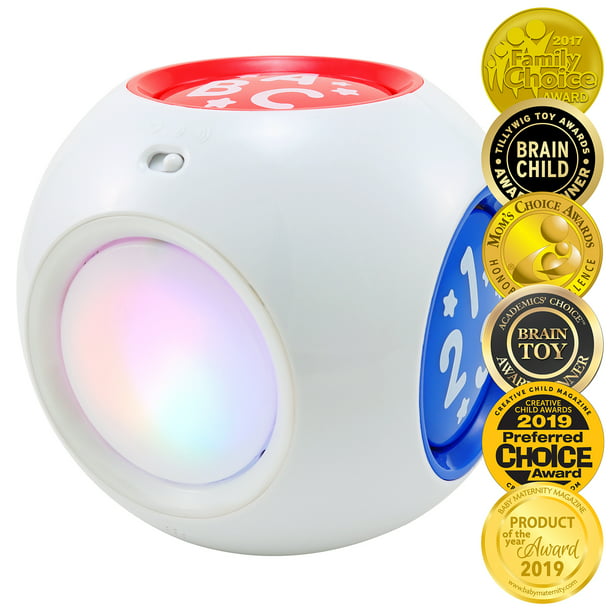
Learning Cube – Six sides, six things to discover: the alphabet, numbers 1 to 10, six colors with blinking lights, 15 animal sounds, 12 instrument sounds and 10 songs. A simple press is all it takes, which is why it works so well for the youngest learners. Recommended age 6 months and up.
Whack & Learn Mole – Whack a mole, learn a letter, number or color. Letters A to Z, numbers 1 to 12, color games, and a sleep mode that plays 10 classical pieces and works as a night light. Recommended age 6 months and up.
My Spin & Learn Steering Wheel – A 360° spinning wheel that teaches colors, shapes and emotions through songs, with rings and beads for tactile play. Two volume levels. Recommended age 6 months and up.
From 12 months: counting, colors and the alphabet
Mushroom Garden – Light-up mushroom buttons teach numbers (count the white dots on each mushroom) and colors. Rock the toy to play melodies, or press the mushrooms to make your own tune. Memory and pattern games get harder as the child improves. Recommended age 12 months and up.
Shake & Learn Alphabet – Insert one of 13 double-sided plastic cards, then press or shake to hear the letter, word and sound. Three modes: read, quiz and music. Themes include animals, vehicles, objects and instruments. Recommended age 12 months and up.
From 2 years: letters, words and shapes
Touch & Learn Tablet – A first "tablet" with no screen. Letters A to Z with pronunciation and spelling, shapes and emotions, a sing-along ABC song, plus quiz and memory games. Two learning stages so it grows with the child. Recommended age 2 years and up.
INNO PAD – 16 lessons on 8 plastic cards covering the alphabet, numbers, time, colors, shapes, weather, emotions, animals and more, with basic and advanced questions. Portable, with five volume levels. Recommended age 24 months and up.
My Geo-Blox – Five magnetic geometry blocks and a picture book about colors, 2D and 3D shapes. No batteries, no sounds – a quiet, hands-on building toy. Recommended age 24 months and up.
Twirlzzle – Twirl the wheels to go from A to Z, build words, and mix the wheels into funny sentences. Quizzes, songs, and a night mode with a timer. Recommended age 2 to 6 years.
How to choose between them
- For a baby who is just starting to sit and grab: Stack & Learn or Learning Cube.
- For a child who loves to hit things (they all do): Whack & Learn Mole.
- For an early talker working on words: Shake & Learn Alphabet or Touch & Learn Tablet.
- For quiet, screen-free building: My Geo-Blox.
- For a toy that doubles as a night light: Whack & Learn Mole or Twirlzzle.
Frequently asked questions
Are electronic toys bad for toddlers?
Not by themselves. The difference is between a screen the child watches and a toy the child operates. All the toys above are operated by hand – pressing, stacking, shaking, spinning – and use lights and sounds only as feedback.
What age do toddlers learn colors and numbers?
Every child is different. Many toddlers start naming colors and counting to a few numbers between 2 and 3 years, but they hear and recognize them long before they can say them. That is why several toys above introduce colors and numbers from 6 or 12 months.
Do these toys need batteries?
All of the electronic toys above come with batteries included (3 AAA or 3 AA, listed on each product page). My Geo-Blox needs none.
Where can I see the full age range of BEST LEARNING toys?
Browse the 6–36 months collection for babies and toddlers, or the preschool 3–5 years collection for the next stage.