
"Is it time yet?" Every parent hears it many times a day. Learning to tell time gives children a real answer, and a little more independence.
This guide covers when children are ready, the steps that make it easier, and how a talking learning clock helps them practice on their own.
When can kids learn to tell time?
Most children learn in small steps over a few years:
- Age 3 to 4: they start to understand "before" and "after", like lunch comes before nap time. They can learn the numbers 1 to 12 on a clock face.
- Age 5 to 7: they can read the hour ("3 o'clock") and half hour.
- Age 7 to 8: they read time to five minutes, then quarter past and quarter to.
US schools follow a similar path. In the Common Core math standards, first grade covers time to the hour and half hour, and second grade covers time to the nearest five minutes, with a.m. and p.m.
Every child is different, so use these ages as a guide, not a rule.
How to teach time: 5 simple steps
- Learn the numbers 1 to 12. Point to them on a clock and count together.
- Hour hand first. Show that the short hand points to the hour. Practice "o'clock" times only.
- Add the minute hand. Explain that the long hand moves around the whole clock in one hour.
- Half past, then quarter past and quarter to. Fold a paper circle in half and in quarters to show the idea.
- Connect it to real life. "At 7 o'clock we read a story." Daily routines make time real.
Short, fun practice every day works better than one long lesson.
How a talking learning clock helps
A clock on the wall does not explain itself. A learning clock does. Your child moves the hands, presses a button, and hears the time out loud. That instant answer helps them check their own work without an adult.
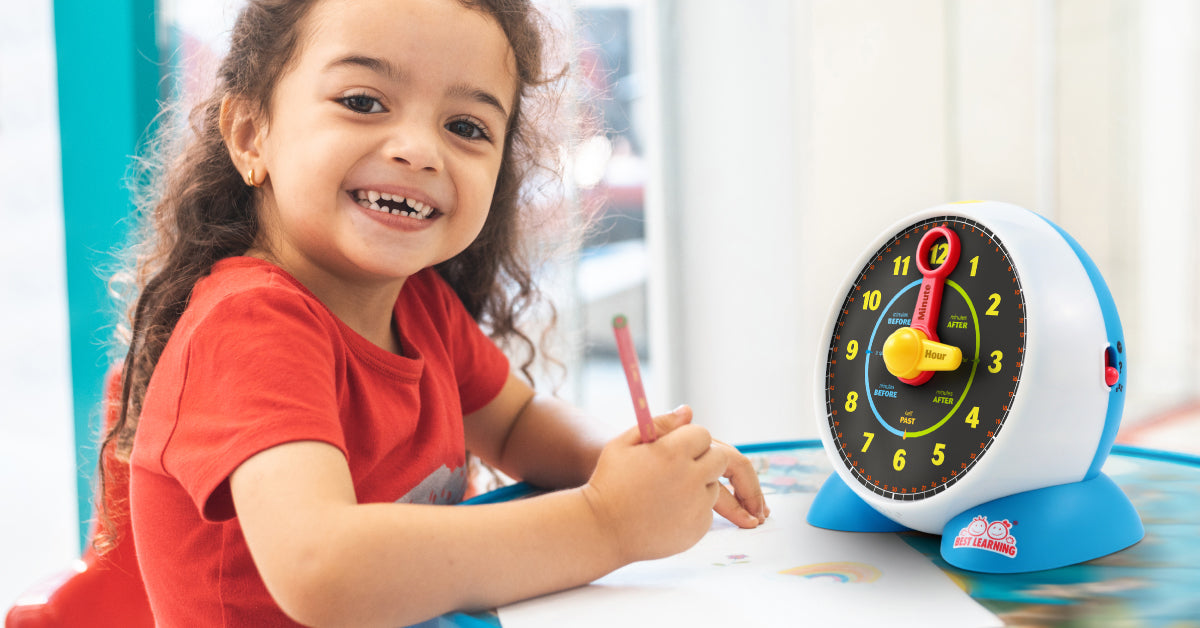
Our Learning Clock is made for this:
- Says the time out loud in different ways: o'clock, minutes after and before, half past and quarter times
- Movable hour and minute hands that turn forward and backward
- Quiz mode: the clock asks for a time and your child sets the hands. A green light cheers a right answer, and there are 3 tries when an answer is wrong
- 3 modes your child can switch alone: Time, Quiz and Sleep
- Sleep mode: 10 classical lullabies and a soft colored night light, with a timer up to 60 minutes
- 2 volume levels, easy-carry handle and slip-proof base
- Size about 6 × 5.9 × 4.3 inches. 3 AAA batteries included
- Recommended age: 3 years and up
Tips to keep practice fun
- Make it a game. Ask "Can you show me 4 o'clock?" and let the clock check the answer.
- Use it at bedtime. Set the time together, then switch to sleep mode.
- Praise effort, not speed. Telling time takes months. Small wins matter.
- Mix in a real clock. Once your child reads the learning clock, ask them to read the kitchen clock too.
Frequently asked questions
What age is a learning clock for? Our Learning Clock is recommended from age 3. Children can start with numbers and o'clock times, and keep using quiz mode as they grow.
Should my child learn analog or digital time first? Many teachers start with an analog clock, because it shows how time moves around the hour. US first-grade standards include both analog and digital clocks.
Can a 3-year-old really learn to tell time? Usually not fully. At 3, the goal is numbers, "before and after", and daily routines. Reading the clock comes later, step by step.
More ideas for preschoolers: shop Pre-school toys (3–5 years), or see our educational gift guide by age.
Free shipping on US orders of $45 or more.